
Exhibition | T. Allen Lawson: Insomnia / Inferno
April 4 - 30, 2026
T. Allen Lawson, Insomnia / Inferno Catalogue
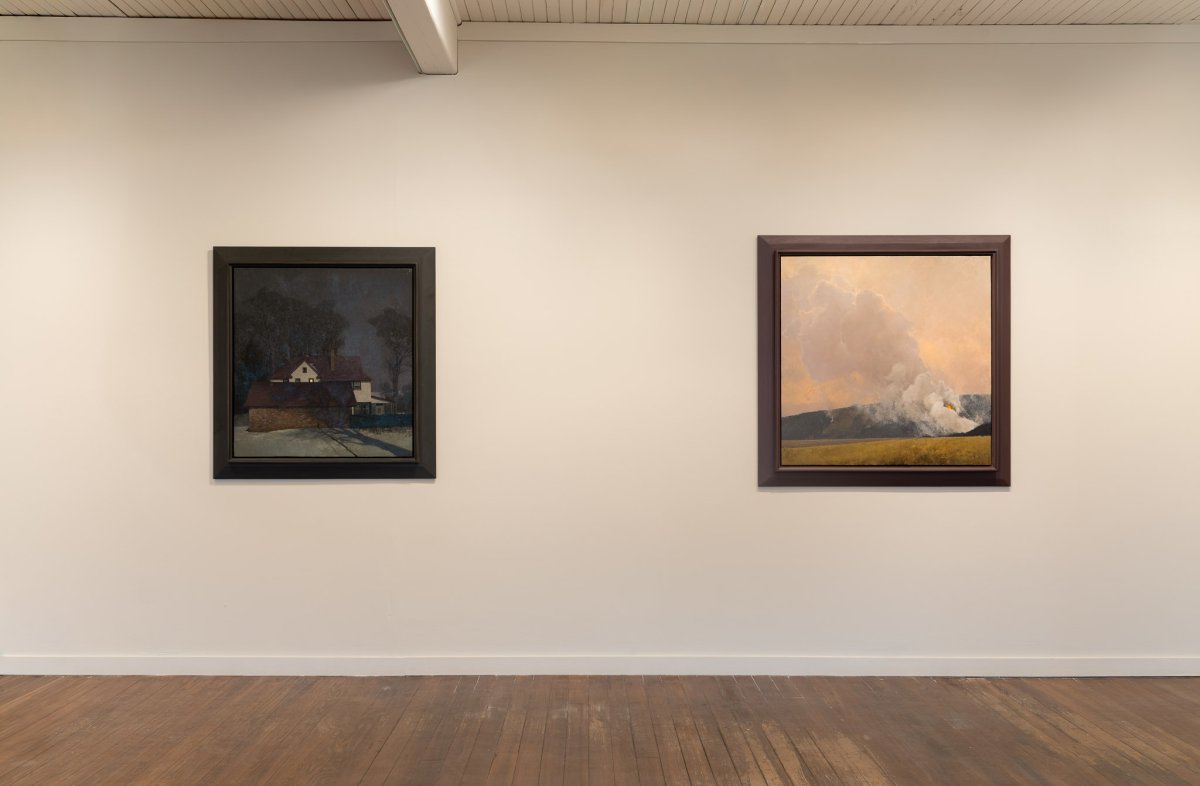
Page Gallery is pleased to present Insomnia / Inferno, a solo exhibition featuring two American landscape paintings by T. Allen Lawson. Painted from Lawson's home in Sheridan, Wyoming, each of these paintings was created as a distinct work. One view looks to a neighboring home, and the other, just steps away, observes the distant hills. As these paintings evolved over several years, parallels emerged along with a desire to show them as one. Closely linked in concept and execution, they reflect on national moments of unrest.
POINT OF ILLUMINATION by Dana Nielsen Clark
Beneath the wind-combed plains of Wyoming, black seams of coal have smoldered underground for hundreds of years. Only in the last century have mines opened the seams to fresh oxygen and droughts lowered the water tables that keep the fires dormant. Wisps of smoke make their way to the surface, and in the driest seasons set the forests and grasslands alight.
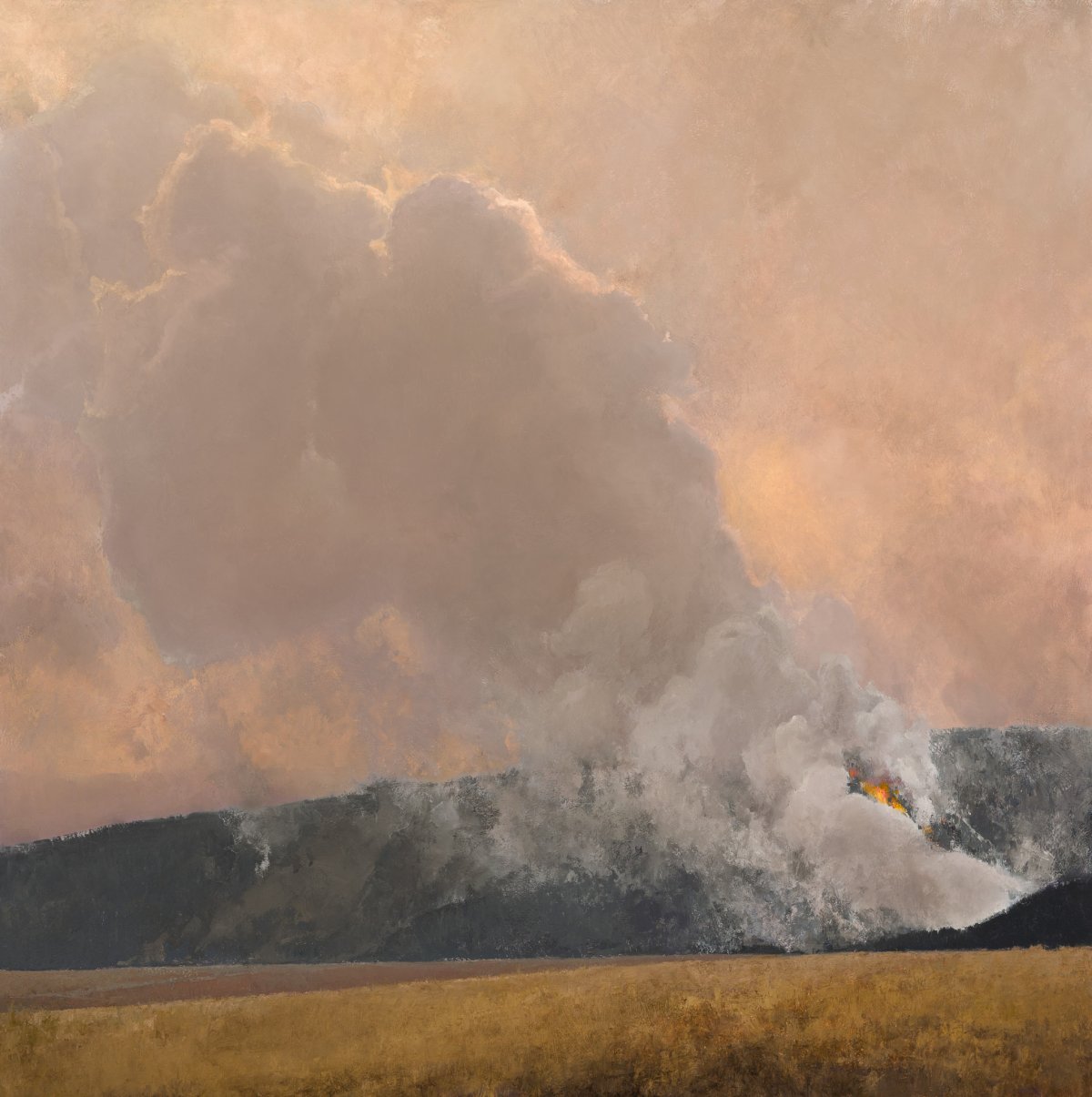
Smoke bloomed over Wyoming in 2024 during a fire season that burned more than 850,000 acres. In Sheridan, a county in the state’s northwest corner, T. Allen Lawson watched a trail of flames climb the ridge of the Bighorn Mountains and move fast toward the Powder River Basin he grew up in. The basin holds the largest reserves of coal in the United States, and while American coal production is most associated with Appalachia, Wyoming is the nation’s leading coal producer. Taxes on industrial coal generate hundreds of millions in tax revenue, funding schools, roads, and public services. Residents see for themselves the climate is getting hotter and drier, and few dispute the pressure it applies to water supply and agriculture. Yet the state's economy, which operates without an income tax, holds tightly onto the industry that built it.
Lawson paints the Cowboy State the way he sees it and Inferno – an aching portrayal of the landscape he’s paid such close attention to for forty years – is no exception. What changes is the land itself. Beyond coarse ochre reeds, the forested Bighorns lie subdued beneath a celestial gloam of soot, heavy and rising in layers of milky peach and gray-lilac. Reserving bright flashes for the odd firework or quaking aspen, the artist’s typically restrained palette, reaches a new note – cadmium orange and yellow – in the small, high-pitched flame that sounds across the hillside.
Although the effect feels spontaneous, the sky in Inferno is a careful orchestration of color that brings some tones forward and pushes others back until the most distant plumes carry the light of the sun. Such convincing illusions are not improvised. Over decades, Lawson has constructed elaborate color charts, each mixing two colors on his palette in ascending scales of chroma and tone. He takes them out to the field to make his color selection for a new composition. Like any colorist, he is interested less in color than he is in their relationships. The charts help him choose hues that vibrate against one another while belonging to the same atmospheric chord.
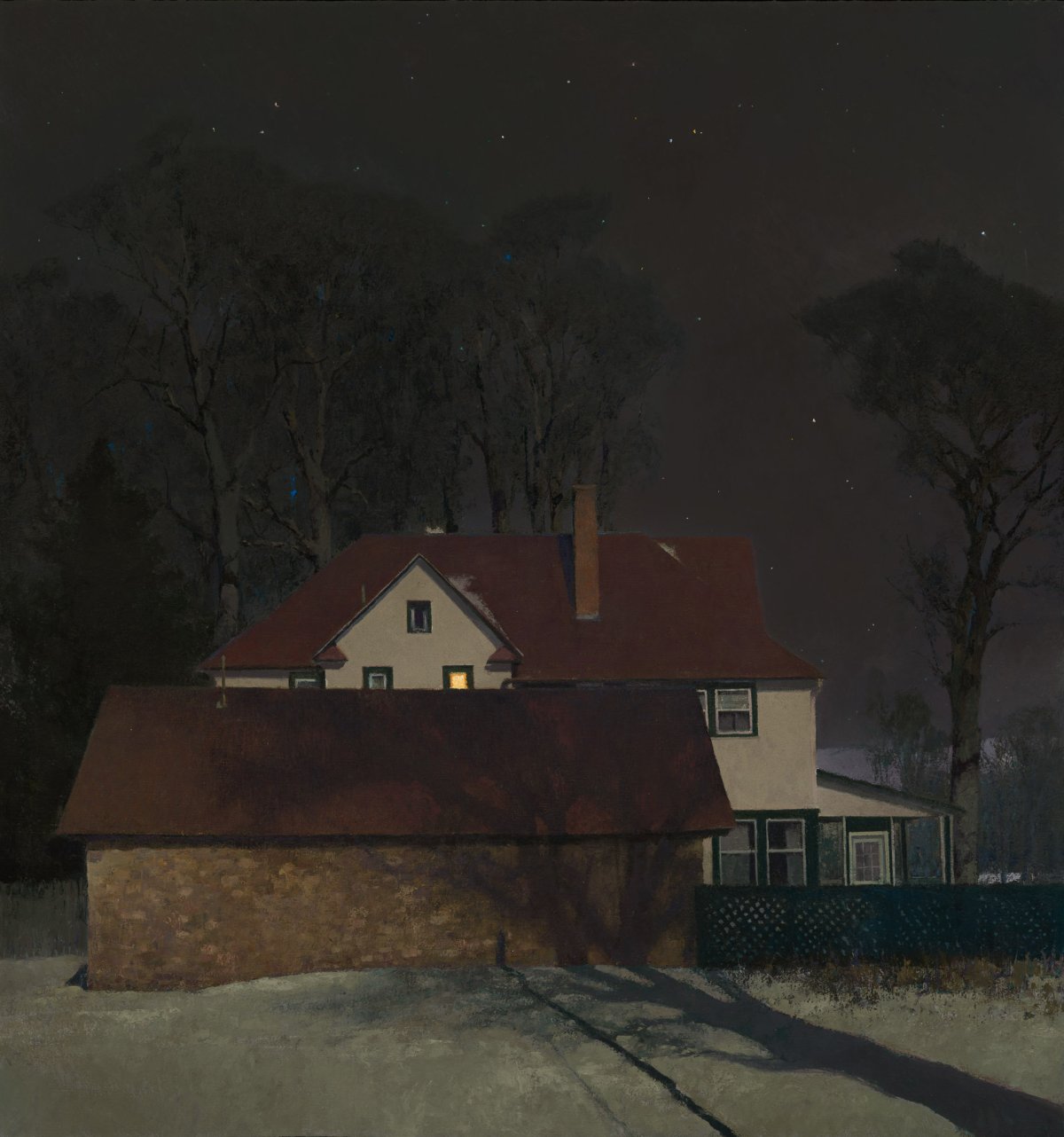
Lawson began Insomnia, a narrative companion to Inferno, when his family lived on a working ranch in Wyoming. It was 2016 and the nation carried a restless charge that followed the artist into the quietest hours of night. He and his wife, Dorie, slept in the living room of a guest house while their children took the bedrooms. The painting depicts his view of the accretionary farmstead.
The moon in Insomnia is full, casting aluminum-thin light from behind the viewer’s shoulder. A long shadow looms across the foreground, its dendritic arms reaching over the stone shed that obscures the white house just beyond it. Towering silhouetted cottonwoods stand against a backdrop washed in silvery night. In one half-visible second-floor window a lamp light glows, a point of consciousness that burns night after night.
Painting isn’t the only medium to isolate a single point of intense illumination within an otherwise muted field. In Anton Chekhov’s The Schoolmistress, the reader follows a weary teacher on her carriage ride through miles of monotony and mud in provincial Russia until a train’s windows flash by, gleaming with the low sun. “There rose before her mind a vivid picture of her mother, her father… their flat in Moscow… the sound of the piano,” suddenly calling forth a childhood memory of love and belonging that restores her. In Sonny’s Blues, James Baldwin’s portrait of mid-century Harlem finds a similar moment of transcendence in Sonny’s performance at a smoky jazz club. On his piano a glass of scotch and milk “glowed… like the very cup of trembling,” a halo of redemption that teeters at the edge of darkness.
It is hardly surprising that we tie light so closely to human consciousness, a connection that underlies our most enduring myths. In the Book of Genesis, God commands, “Let there be light” and it appears before the sun and stars themselves as divine awareness that precedes form. Prometheus stole fire from Mount Olympus and delivered to humankind the flame; there civilization begins. Combustion lifts us from the animal world, but at a cost.
It was Dorie who recognized the relationship between Insomnia and Inferno, paintings begun eight years apart. Lawson does not start with concept or theory, but with a patient eye that holds the tension of opposing forces; the lilting range, the ash that rises.
Dana Nielsen Clark writes about art, industry, landscape, and cultural history. She lives in Midcoast Maine.